Your Progress
3D Eye Accessing Cues
Overview
Eye movements are not random — they reflect how the brain accesses and processes internal representations.
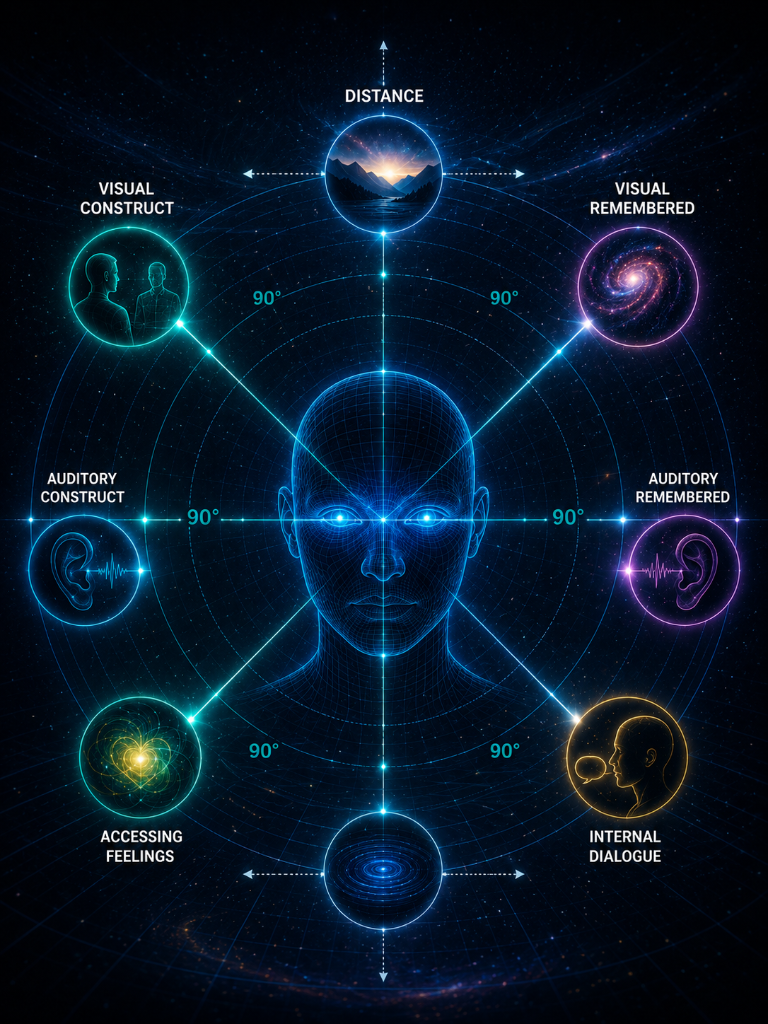
IEMT extends the traditional NLP two-dimensional eye-accessing model into three dimensions.
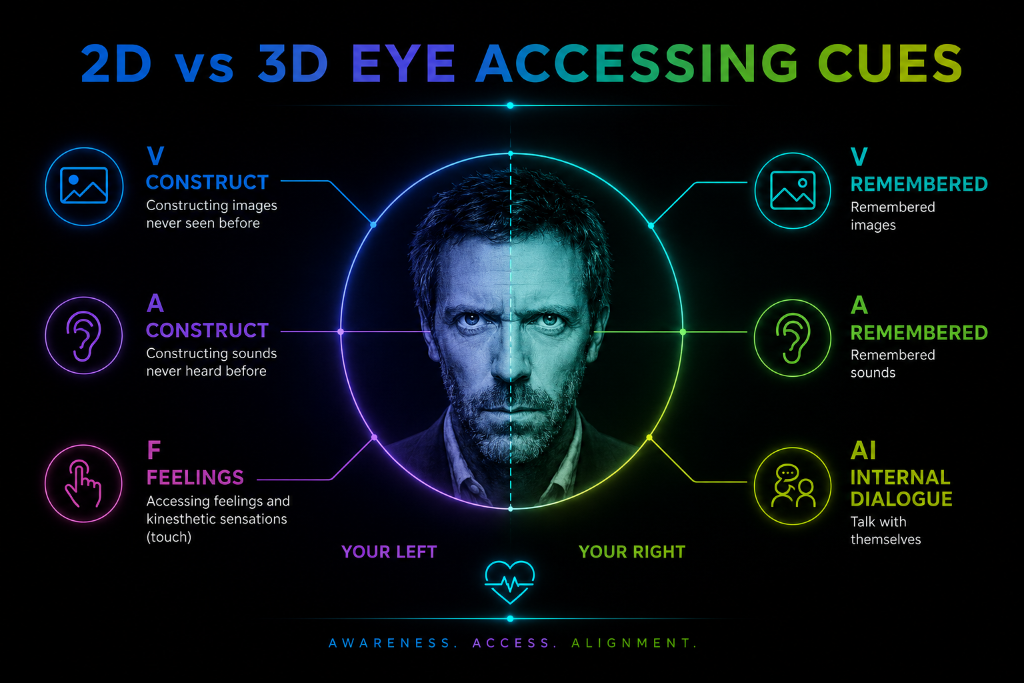 Eye accessing cues in NLP are general patterns that may give some understanding of how a person is internally processing or accessing information.
Key Insight
They are not exact, are not accurate for everyone, and should never be relied upon as truth or lie detectors. They are simply observational guidelines, not rigid rules.
The Three Dimensions
- Horizontal axis — left/right, relating to past/future or constructed/remembered
- Vertical axis — up/down, relating to visual and auditory processing
- Depth axis — the third dimension, reflecting how 'present' or 'vivid' a representation is. In all directions.
- 90 Degrees — this is the range between each area also front and behind
Key Accessing Positions
IEMT practitioners are trained to track not just the direction but the depth of eye accessing — and Deviations little blips.
Main Goal is smooth pursuit.
Practical Application
Observe your client carefully as they think about their issue. Notice where their eyes go and how far they travel. This is your map.
Guided Reflection
1.In 3D Eye Accessing Cues, what does the third (depth) dimension represent?
2.Which eye position corresponds to 'Visual Remembered'?
3.What is the main goal when observing eye movements in IEMT?
4.What does '90 degrees' refer to in the 3D Eye Accessing Cues model?
5.Which eye position corresponds to Internal Dialogue?
Answer all questions to submit