Your Progress
Core Concepts of IEMT
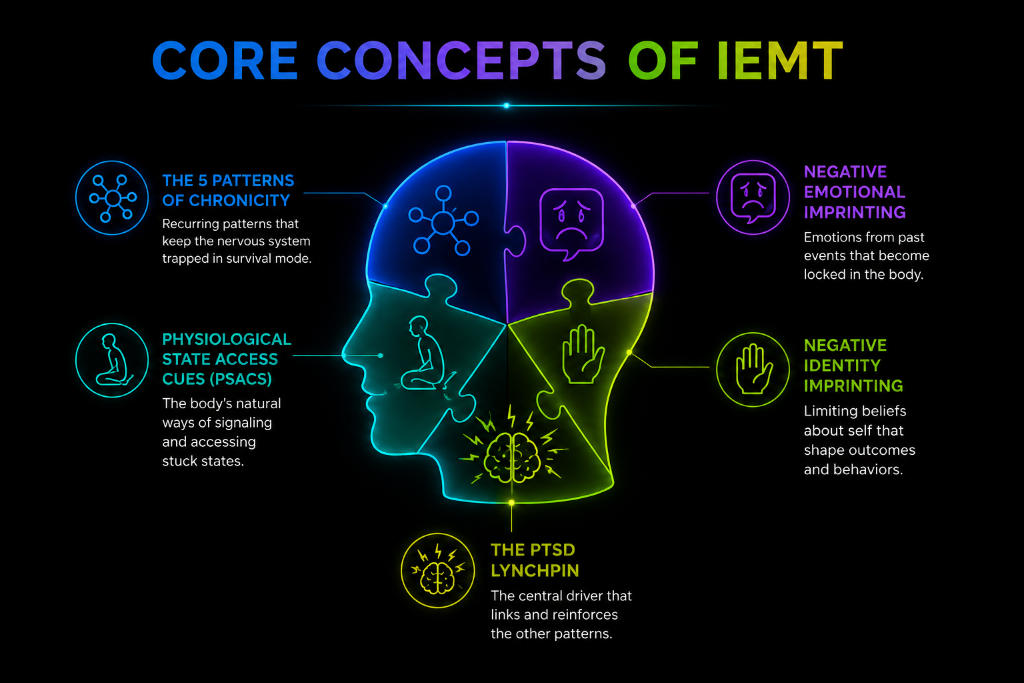 IEMT is built around five interconnected core concepts:
- Negative Emotional Imprinting — Learned emotional responses that have become automatic and disproportionate, stored as felt experiences accessed through specific eye positions.
- Negative Identity Imprinting — Conclusions drawn about the self (often in childhood) that become self-fulfilling, such as 'I am not good enough.'
- The PTSD Lynchpin — The mechanism by which traumatic memories become frozen in time, causing the nervous system to respond as if the event is still occurring.
- Physiological State Access Cues (PSACs) — Observable physical signals that indicate how a client is accessing their internal state.
- The 5 Patterns of Chronicity — The five key patterns that keep problems locked in place and prevent change. Each one plays a distinct role in understanding how problems become chronic and how IEMT creates change.
1. Emotional Memory Imprinting
IEMT works on the memory imprints that activate emotions and feelings. A negative emotional imprint occurs when a person has a new kinesthetic response to an experience or event that may be physically or emotionally intense. This teaches the person's brain how to feel about and respond to future situations.
Key Insight
Example: Your boss calls you into the office because he would "like a word." You immediately have an automatic response as though you were a kid in school being called in by the principal or teacher. This is an emotional imprint. We ask the question: "How did this person learn to feel this way about this thing?"
2. Negative Identity Imprinting
Identity imprinting occurs during lifelong development and is constantly changing and evolving. Many events start to define "who we are" in the problem. "I am a procrastinator"; "I am a PTSD survivor"; "Anxiety is part of me"; "I am afraid of dogs"; "I don't trust myself" etc. We ask the question:
Key Insight
"How did this person learn to be this way about this thing?" In the IEMT model we also address how we see/feel about others.
3. The PTSD Lynchpin
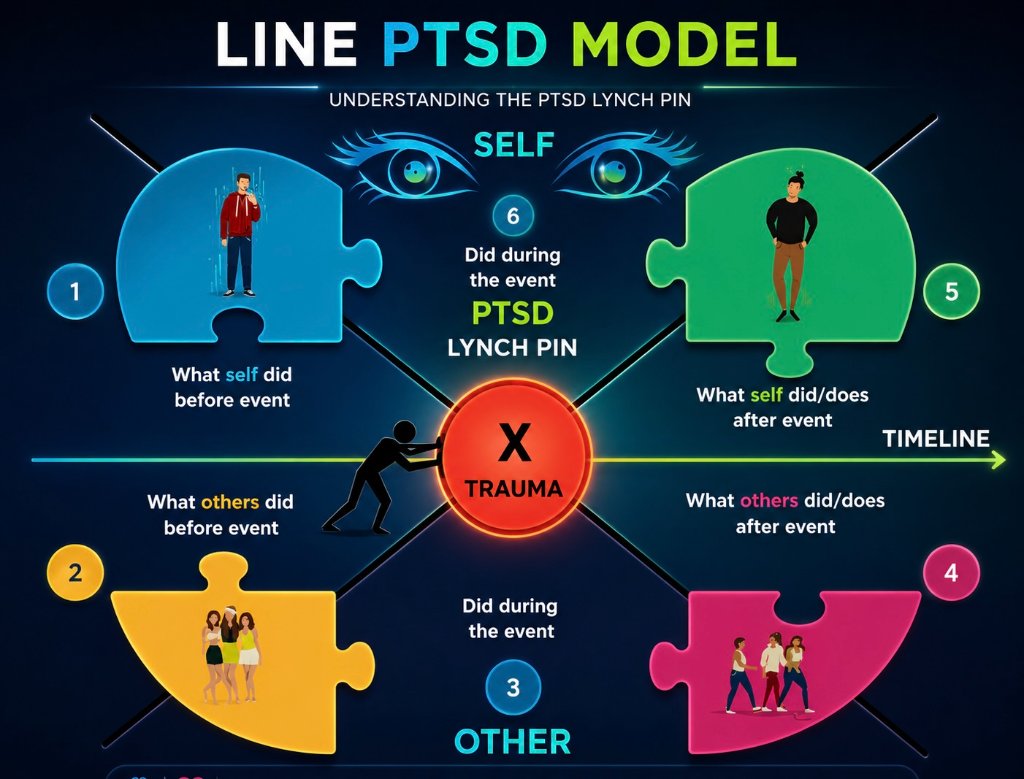 The PTSD Lynchpin is the mechanism that locks traumatic memories in place, preventing the brain from updating them in light of current safety.
When a traumatic event occurs, the brain creates associations across multiple dimensions:
The PTSD Lynchpin is the mechanism that locks traumatic memories in place, preventing the brain from updating them in light of current safety.
When a traumatic event occurs, the brain creates associations across multiple dimensions:
- Self Before/After — Who the person was before the event vs. who they became after
- Others Before/After — How the person viewed others before vs. after the event
- The Event Itself — The traumatic experience frozen in time
- The Timeline — The dividing line between "before" and "after" This multi-dimensional freeze prevents natural healing and keeps the nervous system locked in a protective response pattern. The trauma becomes the reference point for all future similar situations. IEMT works by using precise eye movements to help the brain update these fragmented associations, allowing the traumatic memory to be consolidated and filed away as "past" rather than remaining active as "present threat."
4. Physiological State Access Cues (PSACs)
PSACs are observable physical signals that tell us how a client is internally accessing their experience. They are the body's "read-out" of what the mind is processing. When working with IEMT, paying attention to where a client's eyes naturally move can offer clues about which sensory modality they are accessing when they connect with an imprint.
PSACs to Observe
- Breathing patterns — Changes in depth, speed, or regularity that signal emotional activation or relaxation
- Muscle tension — Tightening in the jaw, shoulders, neck, or elsewhere that indicates defensive bracing
- Skin colour and flushing — Pallor or flushing indicating autonomic nervous system activation
- Posture — Collapse, expansion, or protective positioning that reflects internal state
- Voice tone and speed — Changes in pitch, volume, or speech rate
- Micro-expressions — Brief facial expressions that flash across the face before being suppressed As an IEMT practitioner, learning to read PSACs is essential. They tell you when a client is genuinely in touch with an imprint, when they're defending against it, and when they've successfully updated or integrated it.
5. The 5 Patterns of Chronicity
These five patterns describe the most common ways clients (and sometimes practitioners) inadvertently maintain chronic problems. They are basic defense mechanisms that keep people stuck. The five patterns are:
- The Three-Stage Abreaction — Emotional escalation that follows a predictable pattern
- The Great Big "What If" Question — Fear-based future projections that keep the problem active
- The Maybe Man Phenomenon — Perpetual ambivalence and indecision that prevents resolution
- The Secondary Gain — Hidden benefits of keeping the problem that outweigh the desire to change
- The Emotional Investment — Deep attachment to the problem as part of identity Recognizing these patterns allows the IEMT practitioner to address the maintaining causes of chronic problems rather than simply treating surface symptoms.
Guided Reflection
1.What is Negative Emotional Imprinting?
2.What question does IEMT ask when exploring emotional memory imprinting?
3.What is the PTSD Lynchpin as described in this module?
4.What are PSACs?
5.What is 'The Three-Stage Abreaction' pattern in the 5 Patterns of Chronicity?
6.What is Negative Identity Imprinting?
7.According to the PTSD Lynchpin model, what are the key dimensions that lock a traumatic memory in place?
Answer all questions to submit